

Pranayama (Sanskrit: प्राणायाम, “Prāṇāyāma”) is the yogic practice of controlling the breath
Awareness and control of breathing is fundamental to yoga.
When we practice, we use this awareness and control to bring mindfulness to our movements; to help us come in and out of poses; to enhance stability and posture; and to achieve a calmer and more relaxed state of mind and body.
All of which, of course, can be invaluable in climbing too. This article describes how you can use a better understanding of breathing techniques to benefit your climbing, physically and mentally.
Yoga Woo?
Like many climbers, I can feel sceptical about mysticism, and I generally prefer straightforward physiological explanations of what’s happening in my body, particularly when in comes to climbing performance.
Yoga teachers’ invitations to “breathe in energy” or “breathe out stress” may be helpful visualations for some yoga students, but many climbers are likely to dismiss such cues as “yoga woo”.
So I’ll aim to focus on down-to-earth physiology in this article – with links to further reading at the end.
What Happens during Normal Breathing?
For most of the time, breathing is an involuntary function of the lungs and surrounding muscles, controled by the autonomic nervous system.
At rest, the muscles used for inhalation are the diaphragm, a dome-shaped muscle below the lungs, and the intercostal muscles between the ribs. The diaphragm and external intercostal muscles engage to expand lung volume and draw in air. Oxygen from the air is absorbed into the bloodstream to power the energy-consuming processes of the body (such as muscle movement) and the carbon dioxide waste from these processes is expelled. Exhalation is usually passive, with lung volume reducing as these muscles spring back into place.

When we exert ourselves physically, or when we experience a stress (fight or flight) response, the sympathetic nervous system automatically causes the breathing rate to increase. Additional muscles in the chest, shoulders and abdomen may be recruited to help maximise the air flow through the lungs.
Exploring Purposeful Breathing (Pranayama)
Although normal breathing happens unconsciously and involuntarily, we can gain physiological and mental benefits by breathing consciously and purposefully. Pranayama refers to the yogic practice of controlling the breath to influence the body and mind.
You might like to try the exercises below to explore and understand your own breathing better.
⚠ CARE! While breathing exercises are helpful for many people, THEY ARE NOT SUITABLE FOR EVERYONE. If you have a respiratory condition such as asthma or COPD, or a cardiovascular condition such as heart disease or hypertension, seek medical advice before trying any controlled breathing exercises.
Occasionally some breathing exercises, particularly those which involve holding the breath, can produce feelings of anxiety rather than the intended calm. If you experience this, just stop right away, and allow your breath to return to normal.
Paying attention to your breathing
This is a great way to start, as it allows you to become more aware of your natural breathing before trying to control it.
Sit in a comfortable position on a seat or mat. If your seat has a back, sit forward a little so that your upper body has room to move with your breath.
Pay attention to your breathing, without trying to change it in any way. Notice the feeling of movement up and down the spine, the slight lift and expansion of the rib cage as you inhale. Notice the natural pace of your breathing without trying to alter it.
Now purposefully make your inhales a second or two longer. You may like to try inhaling for a slow count of three or four, and then exhaling for a slow count of three of four. Choose a length that feels comfortable for you.

Directing* your Breath
*It can be helpful to visualise ‘directing your breath’, even though in reality you are recruiting a slightly different combination of muscles to draw air into your lungs.
Into your chest
Place your hands on your chest, just below your collar bone (clavicle). Breathe in fully, focusing on the upper chest. This type of breathing engages accessory muscles in the shoulders and chest. Notice your hands lift slightly with the upwards expansion of the chest. You may also notice your shoulders moving backwards and your spine straightening as your chest opens.

Into your side
With practice you can also direct your breath into one side of your body or the other. Again, by focusing the attention on one side of the chest, you subconsciously recruit the chest and shoulders muscles more actively on that side.

This can help us move into long reaches and awkward twists when climbing – see below for how to practice this.
Exhaling from the Core (forced expiry)
Start by taking a long deep breath to fill your lungs. Let your belly expand at the same time. Exhale naturally to start with, and then continue exhaling as though you want to squeeze every last bit of air out of your lungs†.

Notice how your abdominal muscles reflexively engage to assist the diaphram, including the rectus abdominis and underlying transverse abdominis, both key muscles in core stability.
To make this technique truly effective, practice retaining this deep core engagement while starting again to breath normally.
†You can’t actually expel all the air! There is always a bit of air left in the lungs, known as the Residual Volume.
The next part of this article looks at how an understanding of breathwork can be used for calm, stability and control while climbing, drawing on the basic breathing techniques above.
(For those who are interested, there is a brief overview of some further yoga breathing techniques at the end of this article.)
Purposeful Breathwork for Climbing
The word yoga is derived from the Sanskrit root yuj युज्, meaning to yoke, bind, or unite. So yoga means “union” — of body, breath and mind
For over 2000 years, yogic philosophers such as Patanjali have recognised the connection between breath, mind and emotions. More recently, western psychology and medicine have also recognised this connection, now backed up by numerous scientific studies1, 2, 3, 4. These days, breathing exercises are a standard component in toolkits for stress management, and as part of therapy for people with anxiety disorders.
Slow deep breathing is thought to stimulate the calming parasympathetic nervous system via the vagus nerve. In particular it is thought to improve heart rate variability, allowing your body to respond quickly when needed, then relax and recover afterwards.

So purposeful breathing can be invaluable to a climber – as part of your regular yoga practice, at the start of a climbing session, before starting up a challenging route, or if you find yourself in a difficult situation mid-route.
Pre-Climb Breathwork
There are some people who can just find a quiet place to sit, and use breathing exercises to calm their mind. However this can often be difficult to achieve, especially at a busy crag or wall.
Instead it can be helpful to combine breath and movement, calming and focusing your mind and tuning into your body at the same time. The following movements work well with the breath, and also provide a gentle start to your warm up.


You can also use breathwork during a more focused pre-climb warmup or stretching session.
Inhale before a resistance movement, exhale as you make the movement, for example:

Inhale to extend and open a stretched limb, exhale to sink into a twist or fold, for example:
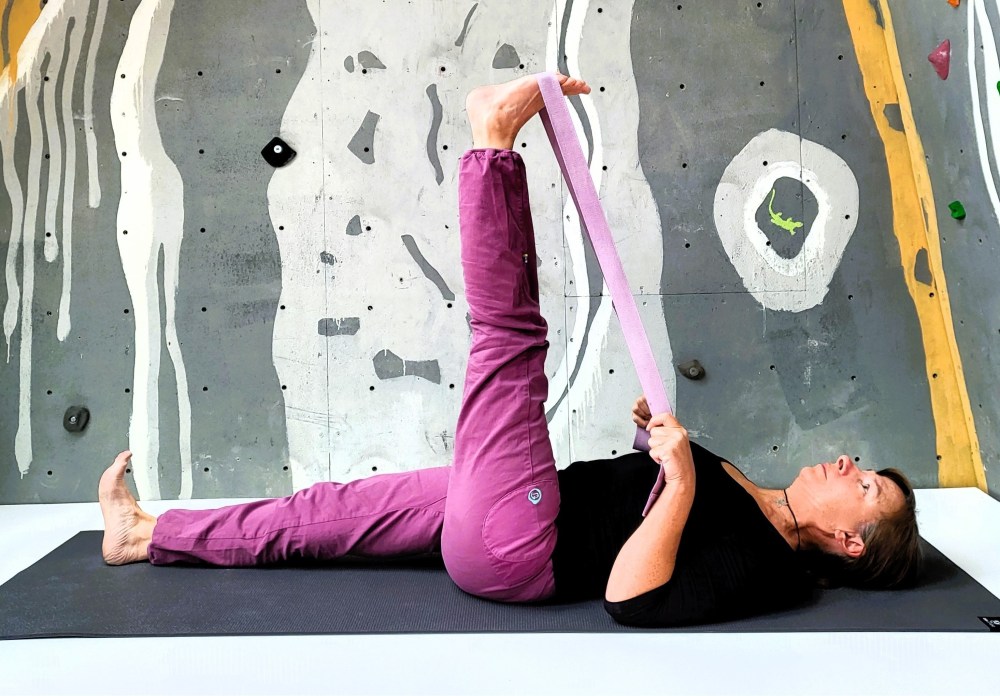
For more about using beathing to guide and deepen your stretches, see the article Yoga Basics: Effective Stretching
Mid-Climb Reset
Even mid-climb, breathwork can help you recover after an intense few moves, or to prepare for a crux move ahead.
It’s best used in positions where you are at least partially resting (feet on decent holds, less than full weight on the arms).
If at least some of your weight is on your arms, shift your body if necessary so that it’s below straight arms. Take a deep breath in. Feel the chest rise, the back extend, the shoulder blades retract. As you exhale slowly and steadily, let your shoulder blades sink down your back. Try repeating this cycle a few times.
As well as helping to reset your mind and to recover from any anaerobic lag, this is a great way to reset your posture, particularly if your shoulders have become hunched with tension. If your weight is at least partly on your arms, you are actually doing a gentle scapular pull-up, positioning and engaging your shoulders ready for a more effective pull upwards.

Mid-Climb Core Control
When you’re making a move which takes you out of balance, a slow, full exhale can help you engage your core strength and stability.
Take a deep breath in, then breathe out with a long, slow forced expiry, as though your are trying to force every last bit of breath out of your lungs. This will engage the rectus abdominis, tranverse abdominis and maybe even the pelvic floor. Do your best to retain this engagement while you keep breathing steadily and make your move.


Helping with Twists (and Long Reaches)
We might expect to twist our bodies when weaving in and out of tufa columns or attempting 3D boulder problems. But we also twist when we make long reaches or use a drop knee. Breathing techniques can make a surprising difference to our range of motion in twists.
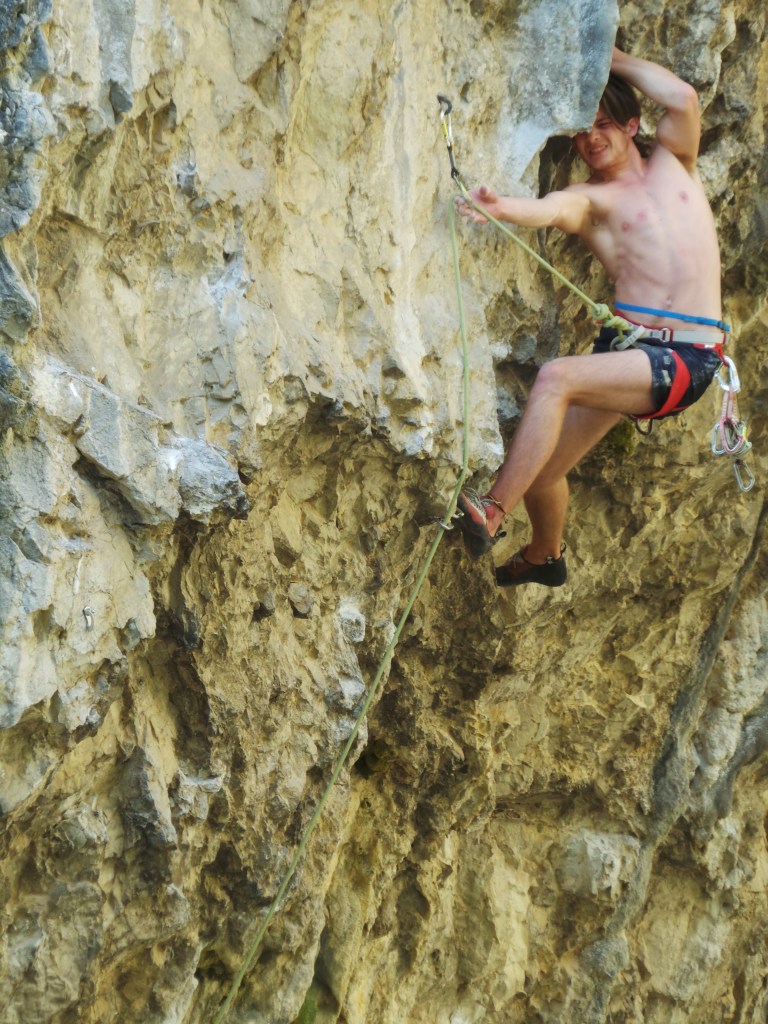
These breathwork techniques are best practiced on the mat before trying them on the rock!
To help you move more deeply into any twist, start by taking a full inhale before you twist. The expansion of the chest cavity helps decompress the discs between the vertebrae so the spine can twist more easily. Exhale as you move into the twist.
For tighter twists and long reaches, you can also direct the breath to open up the shoulders. When attempting to twist the shoulders, the scapulae, ribs, clavicle and the head of the humerus (upper arm bone) are all trying to move past each other. Directing your breath into one side of your chest gives all these pieces a little more space to move.
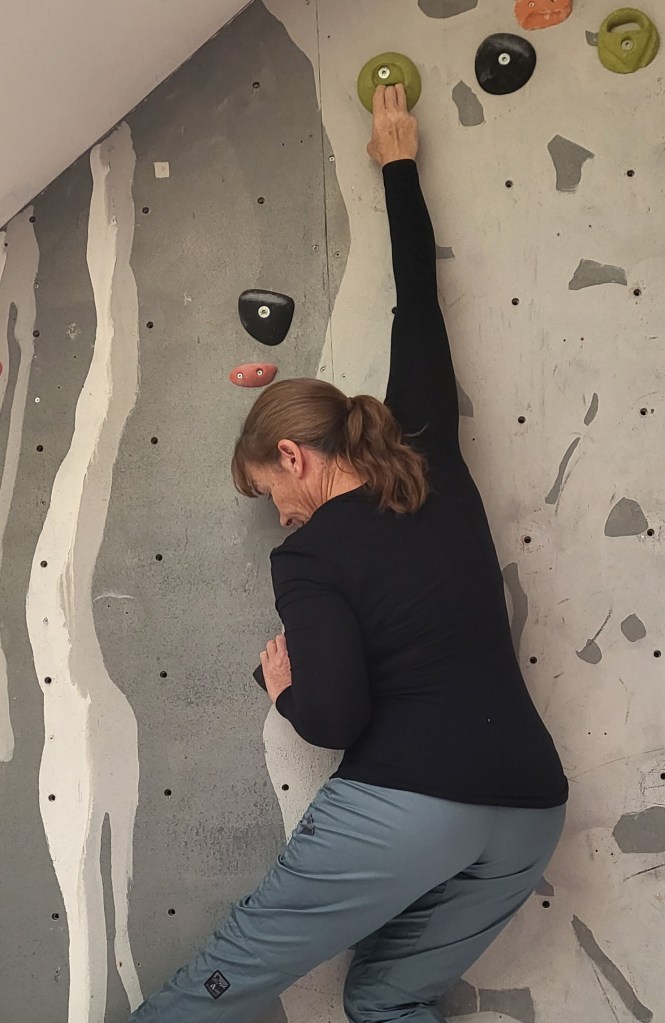
Try it on the mat before trying it on the rock:
- Stand or sit up tall, and hold the right arm out to the right at shoulder height.
- Twist rightwards from the chest, taking the arm back as far as is comfortable. Note where your arm is pointing.
- Take a big inhale – directing your breath into the righthand side of your chest, feeling the righthand side of your chest lift.
- As you exhale, you should find that you can now twist your arm back noticeably further.
- Try the sequence on the other side too – our flexibility is often better in one shoulder than the other.
FURTHER BREATHING TECHNIQUES
In this artice I’ve explained some of the breathing techniques I find most helpful for climbing (and yoga). For those who are interested, I’ve outlined further Pranayama techniques below. READ MORE…
(Of these more advanced techniques, the only one I use regularly is Ujjayi breathing. I find the slow, constricted flow of the breath great for focus and control.)
Ujjayi Breathing: The throat is constricted slightly so that the breath makes a whispering sound, allowing slow, controlled breathing. This type of breathing can be used during yoga poses and flow sequences, before climbing, and for a mid-climb reset.
Three-part Breathing (Dirga Pranayama): If you are new to Pranayama, this can be a good way to gain awareness of your breath. The breath is drawn into the diaphragm, chest and upper chest in sequence, then released in reverse order. The flow should be smooth on both the inhale and exhale.

Alternate Nostril Breathing (Nadi Shodhana Pranayama): The breath is inhaled through one nostril, held for a few counts, then exhaled through the other nostril.

Box Breathing (Sama Vritti Pranayama): The breath is held for a few counts at the end of each inhale. The breath is then exhaled fully, and held for few counts before starting the next inhale.
DISCLAIMER: ALL ACTIVITIES DESCRIBED ON THIS WEBSITE ARE FOR GENERAL INFORMATION ONLY AND MAY NOT BE SUITABLE FOR EVERYONE. ALL EXERCISE CARRIES A SMALL RISK. ANYONE TRYING ANY OF THE ACTIVITIES DESCRIBED ON THIS WEBSITE ACCEPTS THIS RISK AND THE AUTHOR DISCLAIMS ANY LIABILITY FOR ANY ADVERSE EFFECTS CONNECTED WITH THESE ACTIVITIES.
References and further reading
- Jayawardena R, Ranasinghe P, Ranawaka H, Gamage N, Dissanayake D, Misra A. (2020) Exploring the Therapeutic Benefits of Pranayama (Yogic Breathing): A Systematic Review. International Journal of Yoga. 13(2) 99-110 https://pmc.ncbi.nlm.nih.gov/articles/PMC7336946/ ↩︎
- Fincham, G. W., Strauss, C., Montero-Marin, J., & Cavanagh, K. (2023). Effect of breathwork on stress and mental health: A meta-analysis of randomised-controlled trials. Scientific reports, 13(1), 432. https://www.nature.com/articles/s41598-022-27247-y.pdf ↩︎
- Morgan, S. P., Lengacher, C. A., & Seo, Y. (2025). A systematic review of breathing exercise interventions: An integrative complementary approach for anxiety and stress in adult populations. Journal of Holistic Nursing, 43(4), 354-376. https://journals.sagepub.com/doi/abs/10.1177/08980101241273860 ↩︎
- Hopper, S. I., Murray, S. L., Ferrara, L. R., & Singleton, J. K. (2019). Effectiveness of diaphragmatic breathing for reducing physiological and psychological stress in adults: a quantitative systematic review. JBI Evidence Synthesis, 17(9), 1855-1876. https://journals.lww.com/jbisrir/fulltext/2019/09000/Effectiveness_of_diaphragmatic_breathing_for.6.aspxund ↩︎

