
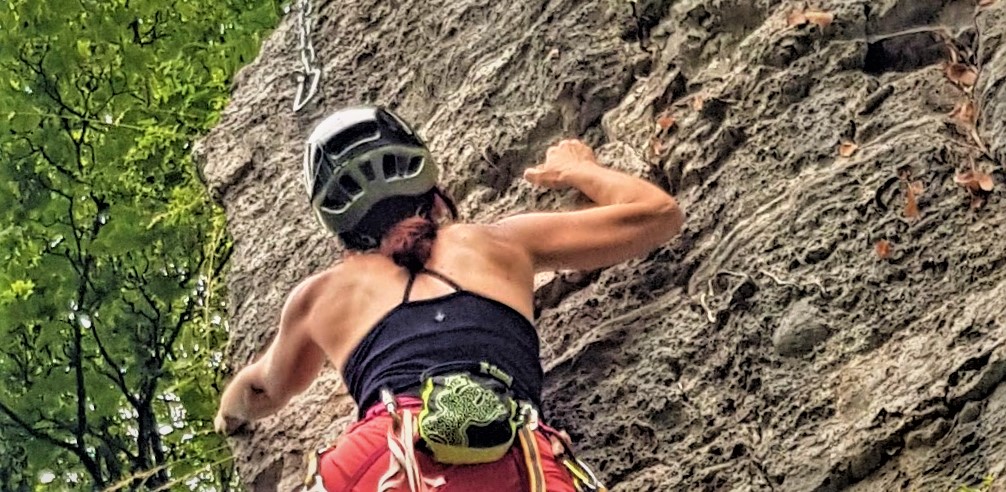
When I mention that I teach yoga for climbers I’m often asked, “So do you teach that weird yoga pose for Climbers’ Elbow?” They’re usually referring to a variation of locust pose advocated by by Tom Randall. (Although this pose clearly works for some, it’s never worked for me, so I tend not to teach it!)
Causes and effective treatments for elbow tendinopathies like Climbers’ Elbow (aka Golfers’ Elbow) must be one of the most contested topics in climbing performance.
While I’ve no intention of contributing to the debate, there’s an emerging consensus that reduced scapular stability and poor posture may increase your susceptibility to elbow tendinopathies1,2. This article explains the importance of scapular stability and suggests how yoga can build awareness, alignment and strength in your shoulders to help you reduce your risk of injury.
⚠The suggestions given here are not a substitute for medical advice.
If you have a problem with elbow pain or shoulder pain, always seek advice from a qualified health professional such as your family doctor or a physiotherapist about which forms of exercise are suitable for your condition.
What is Scapular Stability?
The scapulae, or shoulder blades, are large, flat triangular bones that sit at the back the rib cage and are held in place by the many muscles of the shoulder girdle. Unlike most other joints in the body, the scapulothoracic joints are held in place by muscles, relying on the interplay of 17 muscles to provide stability for the the arm and shoulder.
Which 17 muscles?
For those interested, the17 muscles are: biceps brachii; coracobrachialis; deltoid; infraspinatus; latissimus dorsi; levator scapulae; omohyoid; pectoralis minor; rhomboid major; rhomboid minor; serratus anterior; subscapularis; supraspinatus; teres major; teres minor; trapezius; and triceps brachii!

Weakness in any one of these muscles, particularly in the larger muscles such as the serratus anterior, latissimus dorsi, rhomboids, and trapezius muscles, can affect the way the scapulae move and how the shoulder joints function.
The shoulder requires both mobility and stability in order to support and stabilize arm movements. Poor movement patterns or deficits in muscle strength at the scapulae can lead to uncoordinated movement and instability in the elbow, wrist, and hand. By not using the larger, stronger muscles closer to the body we risk overuse of the smaller muscles in the rotator cuff and arm, and consequent risk of injury and pain.
What is the rotator cuff?
The rotator cuff is a group of muscles and tendons that surround the shoulder joint, keeping the head of the upper arm bone firmly within the shallow socket of the shoulder.
Of the 17 muscles connecting to the shoulder blade, three are particularly important for maintaining stability:
- Trapezius (mid and lower) – retracts (pulls back) and lowers the scapulae, and controls rotation of the scapulae to allow upward motion of the arms (e.g. when reaching for a hold)
- Rhomboid – retracts and raises the scapulae
- Serratus Anterior – protracts (pulls forward) the scapulae
The balance between these muscles acting in different directions is what provides stablity for the shoulders.
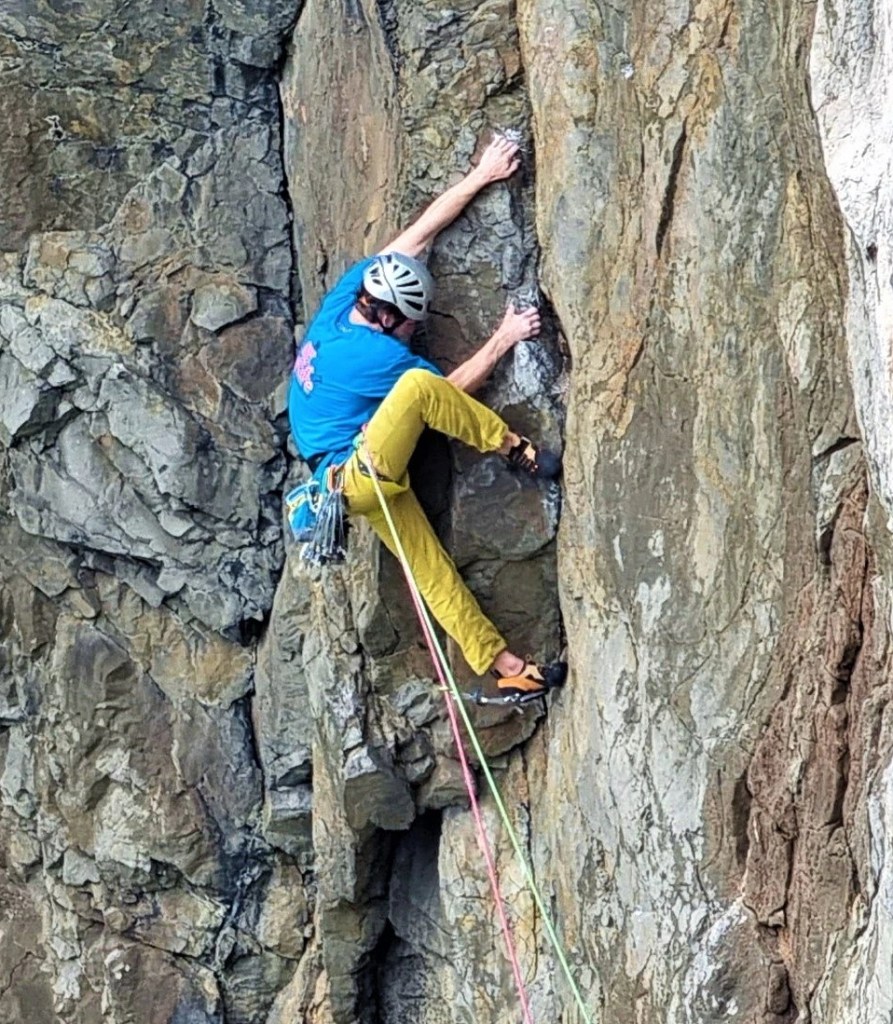
Protraction of the shoulders is inevitable as we pull ourselves into the rock. As a result, climbers tend to have tightness across the front of the shoulders, pulling the scapulae forward. We need to ensure that the trapezius and rhomboids are strong enough to balance that tightness by pulling scapulae back into place.
Yoga poses for shoulder stability
You can be paying attention to your shoulders throughout your yoga practice. A good teacher will regularly be encouraging or reminding you to improve your posture and alignment of your shoulders. Common cues like ‘roll your shoulders up back and down‘ and ‘draw your shoulders away from your ears‘ are intended to help you engage the full range of muscles to support your shoulder blades safely.
Some poses particularly suited for developing scapular stability are described below.
⚠ The poses listed here are for general information only and are not suitable for everyone.
Always seek medical advice before making significant changes to your physical activities.
Chaturanga Dandasana and Vinyasa Flow
Chaturanga dandasana (yoga press-up) is an integral part of a vinyasa transition, and may be repeated many times in a vinyasa flow yoga class. As such this can be an excellent way to develop strength in the shoulder girdle – but only if you use good technique, finding the right balance in your muscles before you start.
This short tutorial by the incomparable Rachel Scott is a great introduction.
If you find it hard to maintain good form in your chaturanga dandasana, you can keep your knees on the ground while you build up strength. You can also practice the full pose with a block to support your pelvis (even with the prop it’s a great workout for your shoulders!)
Downward Dog and Variations
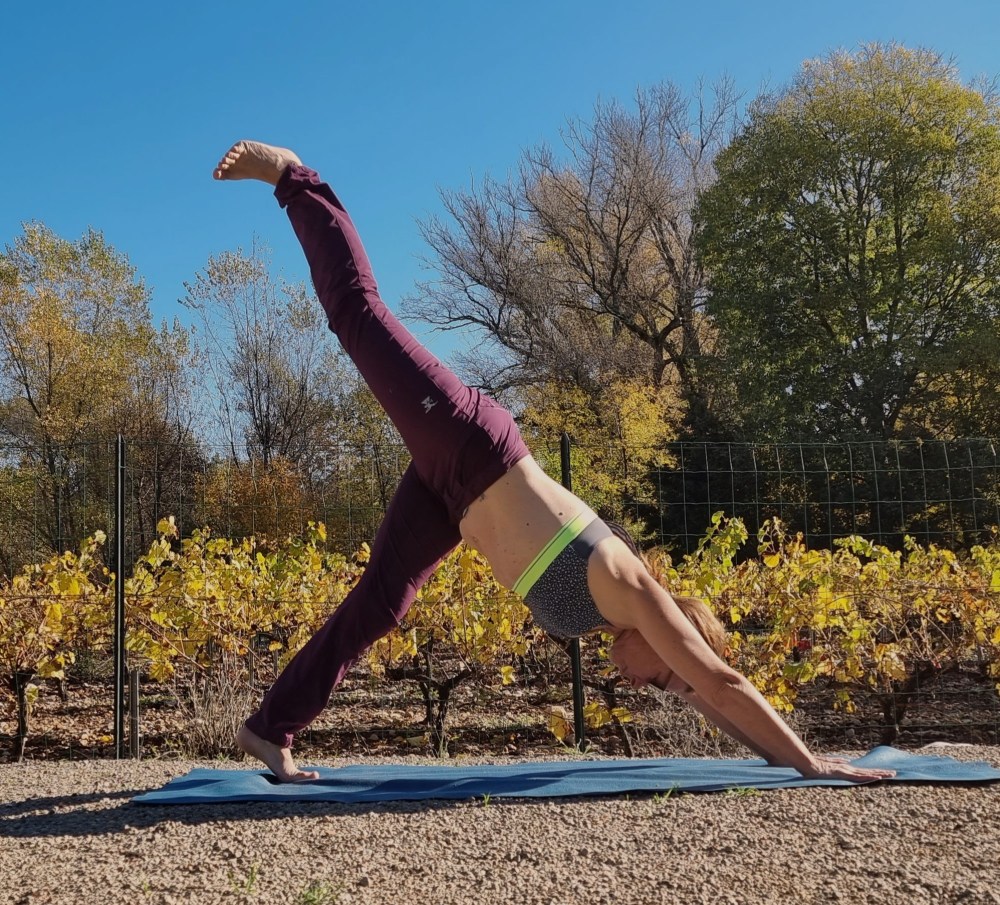
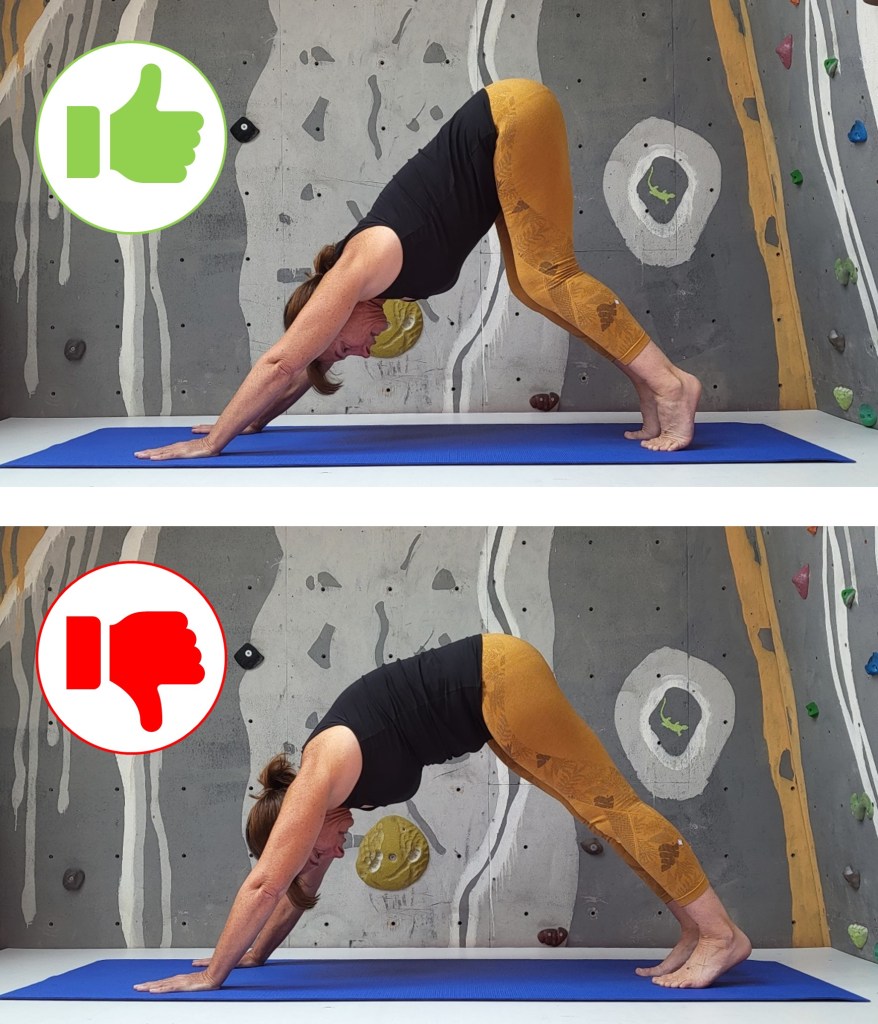
Downward Dog (Adho Mukha Svanasana) is great for building awareness of what your shoulders are doing while they are stretched beyond your head (as they often are when climbing). To ensure that your shoulders are correctly engaged before you push your hips up and back, plant your hands firmly with middle fingers facing forward, and then rotate your biceps and inner elbows forward. Feel your shoulders open and flatten.
As you push your hips up, your back and arms should form a long straight line from wrist to hips.
Many active people are too tight in the hamstring to do this easily with straight legs, so feel free to bend the knees as much as you need.
Far better to have a straight back and strong shoulders than to bend your back awkwardly in the attempt to straighten your legs.
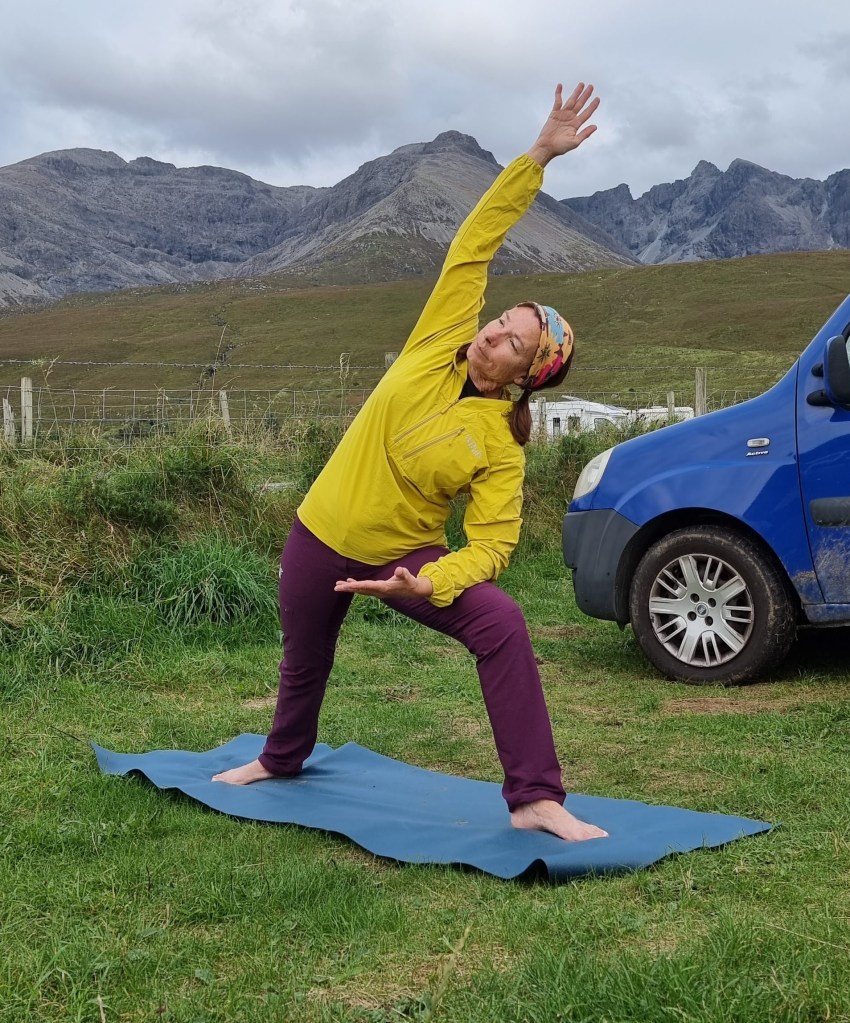
Extended Side Angle
Research by Chopp-Hurley and colleagues3 suggests that Extended Side Angle pose (Utthita Parsvakonasana) is one of the more effective standing poses for shoulder engagement.
Cuillin backdrop optional 😉.
Locust Pose
Locust Pose with arms forward is one of the most effective poses for developing all-round scapular stability, according to Chopp-Hurley and co. I have also included a variation with hands clasped behind the hips – it’s not such a strong muscular workout but great for stretching out a tight chest.
In either variation, ensure that your glutes and abs are fully engaged to protect your lower back, and stretch your toes back to balance the action of the upper body.

Finally….
There’s no research evidence, and I can’t think of any convincing biomechanical explanation, but I always find Eagle pose (Garudasana) feels therapeutic and comforting when I get occasional elbow twinges.

My own Climbers’ Elbow journey
For me, climbers’ elbow started with a finger pulley injury 15 years ago. As the pulley injury healed, I trained too intensively in order to regain my previous strength, and within a few short weeks my elbow was giving me far more trouble than my finger. Three factors led to my elbow pain impacting my climbing for well over a year.
– 15 years ago, advice for climbers’ elbow was to stop climbing completely until all pain was gone
– I was working on my doctoral thesis and spent many hours a day hunched over a laptop
– Juggling a teaching job, doctoral research and childcare, my time was so short that whenever the elbow pain started to ease, I dashed out and tried to climb routes which were too hard for my level of fitness.
The breakthrough came when my partner broke his arm just before a week’s climbing in Spain. Starting on F4 sport routes and spending a week working our way up through easy grades together was just what my elbow (and the rest of my body!) needed.
The following year I started learning yoga… and have not had more than a short term twinge since, despite climbing more intensively than ever in the last few years🙏


DISCLAIMER: ALL ACTIVITIES DESCRIBED ON THIS WEBSITE ARE FOR GENERAL INFORMATION ONLY AND MAY NOT BE SUITABLE FOR EVERYONE. ALL EXERCISE CARRIES A SMALL RISK. ANYONE TRYING ANY OF THE ACTIVITIES DESCRIBED ON THIS WEBSITE ACCEPTS THIS RISK AND THE AUTHOR DISCLAIMS ANY LIABILITY FOR ANY ADVERSE EFFECTS CONNECTED WITH THESE ACTIVITIES.
References and notes
 Vertical Yoga